
“Ah, push it, push it real good.”
-Salt-N-Pepa. “Push It”
I despise push notifications on my phone, to the point where I go through the process of personalizing settings to avoid receiving them no matter the app. Of course, I will admit that I have missed a few important things here and there.
I am not the only one who feels this way. Past research has shown that push notifications increase the number of daily interruptions a person experiences, are considered aggressive and intrusive, spread disinformation, are bias, and can straight up make people stressed out and angry.
So, as any normal person would do knowing the above risks, I decided to torture myself and analyze push notifications from five mainstream news outlets for a month. No filters, no personalized settings. It quickly became three outlets after suffering through a barrage of CNN and Fox News stories and “stories” in one day.
You’re being kind of pushy
The purpose of this study was to see if push notifications from credible news outlets could be considered clickbait, which is usually affiliated with sensationalism and non-credible outlets.
As a former copy editor who used to write headlines for print, I admire the creativity and expertise it takes to offer a clever headline that captures the essence of the story, all while restricted to a font size and preset inches. The online realm is different. Space isn’t as big of an issue, and the purpose of a push notification is to entice the reader into entering the full article. With print, that wasn’t the case. The reader already purchased the paper, so they entered all the articles without reading all the headlines, essentially.
The final three news outlets analyzed, selected by monthly circulation and/or online visitor statistics, were The Associated Press, The New York Times and The Wall Street Journal. Two other researchers and I analyzed 639 combined push notifications from these three outlets, never clicking into the article to avoid feeding the algorithms, and determined there were three styles of clickbait used: a question or teasing phrase, a nameless person or entity or a quote, and sensationalistic, dramatic or exaggerated phrasing.
But I thought clickbait was bad? Well, it still is, but it is also strategic.
We found that The Associated Press used clickbait 59.93% of the time, The New York Times 65.25% and The Wall Street Journal 64.36%. Here are some fun examples:



So what, right? Who cares what the three of us think? How we perceive things are different than how the rest of America does. I’m glad you brought this up. So we surveyed a probability sample of 368 random Americans do see what they thought.
It turns out our perception of clickbait was low compared to others. We strategically selected 30 push notifications (10 from each outlet), and presented them to the participants verbatim, but without the outlet’s name. These pushes were a mixture from each day of the week, different departments, breaking and non-breaking news, and from each clickbait style, including what we considered to not be clickbait.
We also provided a list of 10 outlets for the participants to select if they considered them credible, including The Associated Press, The New York Times and The Wall Street Journal.
Turns out participants considered all push notifications as clickbait, ranging from 62.9%-90.6%, depending on the push. Here was the one considered the most clickbaity:
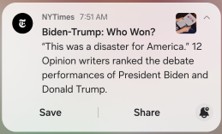
Oh, and participants also found the three outlets to be credible, and there was strong statistical significance between perceived credibility and perceived clickbait usage of the three outlets.
Therefore, the concept of credible clickbait was born.
Here’s how push notifications completely hijacked a man’s summer
Hopefully you didn’t try to click on that. It was only underlined, not linked. I wouldn’t dare do that to you. But. you can actually read the full study here in Journalism and Media, if you want. I swear.
Through a torturous month of too many notifications on my phone leading to too much screen time, and the subsequent analysis of the results, I sacrificed my time off to make sure like three people read this. The results of the analysis and survey underscore that clickbait doesn’t necessarily have to tow along a negative connotation. Of course, that is contextual, because there are outlets who abuse the strategy just to gain views and revenue. However, credible news outlets also need revenue.
Yet, it isn’t just about survival for these outlets, it’s about making sure the public are receiving accurate information during their news consumption. There were some disturbing trends found in the survey data. Though The Associated Press, The New York Times and The Wall Street Journal were considered credible by participants, they weren’t considered the most credible. CNN and Fox News ranked first and second, respectively, but notoriously non-credible outlets were ranked higher than the three analyzed, and this may be because they offer their “news” for free. This is dangerous; this is how disinformation and misinformation spread and shape unverified narratives that may negatively influence society.
Unlike stupid studies shared on stupid sites. Wait a minute? Am I one to talk? Now I have to waste more time reflecting, or whatever.
Moving forward
This study is more than just about push notifications and clickbait; it points out broader issues and modern strategies in the news industry, and how disinformation and misinformation can be communicated for the sole sake of making money. It also shows some unsettling trends on how people consume news, what they believe is news, and how desensitized they are to clickbait.
Just be mindful of what you read and take a page out of journalism’s principles and verify the information through other sources.
Oh, and thanks for the click by the way.

 Carl Lawrence Knauf